Allerød Municipality
Better traffic management with artificial intelligence
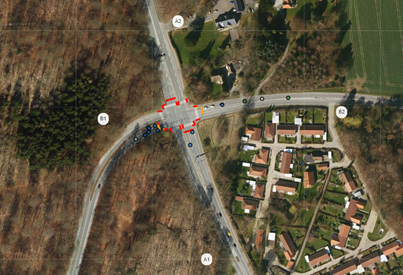
The Kongevejen/Ny Møllevej intersection in Allerød Municipality received a new signaling system in June 2021, and at the same time an IntelliGo optimization box was installed in the control cabinet.
Here, the optimization algorithm maintains shorter turnaround times during peak hours resulting in shorter queues and shorter waiting times for motorists, as well as better accessibility for cyclists and pedestrians.
Challenge
The control principle of the road rules has the weakness that the control only takes oncoming traffic in the direction that has green into consideration, whereas traffic that queues and arrives in the direction with red has no influence on the systems measurement of extension in the direction with green.
Solution
IntelliGo’s signal optimization is based on the type of artificial intelligence called reinforcement learning, and works completely differently from traditional traffic management. Based on radar data on all arriving vehicles from the intersection of different directions, IntelliGo’s signal optimization calculates every second whether it is most optimal to keep green in the direction that has green or to switch to green in one of the other directions. The signal optimization finds the signal phrase that gives the least waiting time for all vehicles at the intersection.
This means that it is not only the incoming traffic in the direction with green that influences whether the green time in a given direction is extended, but also the waiting and incoming traffic in the directions with red.
IntelliGo provides shorter turnaround times during rush hourRegistrations from the intersection in Allerød show a reduction in travel times in the morning of 8-10% and 15-20% in the afternoon, while there is a reduction of approx. 10% in the middle of the day.
A reduction in the turnaround time of, for example, 30% in the peak hours automatically results in shorter queues, as 30% fewer cars must be run in each turnaround.
IntelliGo algorithm shortens the green time and it provides faster circulation. This means that the traffic is settled with short turnaround times when there is a lot of traffic from all directions – and this even though shorter turnaround times are used for faster shifts.
The effect of the shorter turnaround times on queue lengths is shown in figure below. The reduction is still greatest in the peak hours, while there is no effect at low traffic loads.
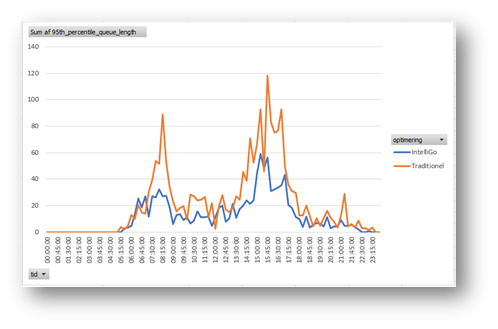
The figure illustrates an example of 95% fractions / quarters of registered queue lengths distributed over the day in a driveway at the intersection Kongevejen/Nymøllevej. Source: IntelliGo traffic statistics.
Conclusion
IntelliGo’s optimization algorithm results in large variations in turnaround time during peak hours, but maintains the short average turnaround time by including all cars at the intersection in the prioritization and not applying the traditional green time extension. The shorter turnaround time means reduced driving times and shorter queues and thus the need for shorter turning lanes or less risk of stowage.
The shorter turnaround times also mean better accessibility for cyclists and predecessors during peak hours.
The effect of using shorter cycles increases the smaller the intermediate times between the phase changes.

Slotsgade 27, 2.
9000 Aalborg

